Certain phrases arise over and over again in my mind during rain walks: upward spirals, increasing possibilities, flows backing up, reducing erosive energy, absorbing solar energy, surface area, slowing rates. Rain walks are about changing rates of flow that shape possibilities, especially those involving Lovelock and Margulis’s idea that Life has used solar energy to lift our Earth far above thermodynamic equilibrium.
As I watch gullies deepen, or watch plants grow more abundantly where once they did not, I sense a fifth dimension underlying the Second Law and the amount of usable energy within a system. The Fifth Dimension spans the rise and fall of usable energy (the ability of energy to do work). This dimension intertwines with the other four dimensions, pervading all space and time, steering every flow in the universe towards less usable energy. The Fifth Dimension defines a primal direction that every living thing orients its behavior by. I play with this dimension during my rain walks. Great flows of water and soil flow “down” while flows of energy from the sun stream in to lift the cycles back “up” so that our “roller coaster ride” can continue.
The Fifth Dimension is hard to think about because we don’t have an easy way to measure it. A meter stick measures the first three dimensions and a clock measures the fourth. The fifth can be sensed in many situations but it is hard to easily measure. We use the dimension of height metaphorically as a visual stand-in for the Fifth Dimension when we say things tend to “run down”. A roller coaster at the top of its first hill has more useable energy than it will at the end of its ride so the ride is a decrease in both height and its useable energy. But the Fifth Dimension is a dimension separate from height. When Lovelock observed that the Earth’s atmosphere was above thermodynamic equilibrium, he wasn’t commenting on the height of our atmosphere. The Fifth Dimension is, also, distinct from the dimension of time. Time can not run backwards locally but usable energy can both increase and decrease locally.
When writing about the dead deer at Big Bend, I introduced this graph:
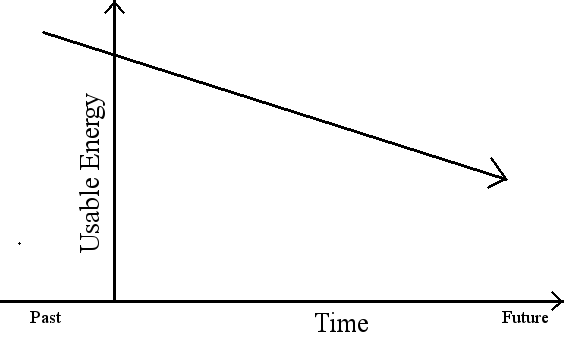 The vertical axis of this graph represents the Fifth Dimension. The Second Law stipulates that when we look at the world this way, we are going to see a lot of changes that graph as a line sloping down, representing usable energy decreasing over time all around us. That is the direction things flow spontaneously. However, because we are an open system, we will also see places where incoming solar energy is absorbed by a system, increasing its usable energy. Both directions (increase and decrease) are possible on Earth.
I have the rain walk experiences of working to hold the runoff as high on the slope as possible so that more of the sun’s gift of fresh water is retained high in the drainage for transpiration and photosynthesis rather than flowing off as erosive kinetic energy. I also have the Chrysalis experience of organizing our school so that as much of a teacher’s ability to creatively respond is retained and available in each moment of teaching rather than being dissipated by top-down directives about what the teacher has to be doing in the classroom. The similarities linking these two very different experiences create my “3D” experience of the Fifth Dimension.
In the field, the retained water allows the area to photosynthesize more sunlight, absorbing more energy, thus more possibilities, into the area. In the classroom, the teacher has more opportunity to adjust the teaching so that a student experiences understanding which lights up their spirit. The student grows brighter, more enthusiastic, more open to the possibilities of life (rather than shutting down to them) and the teacher receives positive feedback that nourishes the teacher’s enthusiasm and increases her/his insight into the person emerging within that student. The classroom becomes more alive, more filled with more possibilities just as the fields do. Both places are moving upwards within the Fifth Dimension towards more possibilities.
Therefore, I’m now going to take poetic license with my graph and change the name of that vertical axis from scientifically measureable “Useable energy” to the fuzzily-defined, intuitive name of “Possibilities”. What I see happening during my rain walks feels very much like what I see happening with kids at Chrysalis which feels very much like the effect rain walks have had on my spirit. All of them are the emergence of more Possibilities.
My initial image of “Possibilities” was two skiers high in the mountains stopping to pick out a beautiful route of descent. One skier has stopped higher on the slope than the other. The lower skier has many routes down available to him. However, the higher skier has more possible routes because one of her many routes is to descend down to the other skier where she then has access to all the routes he has. But she also has available all the additional routes angling across the slope above the routes of the lower skier. She has more possibilities because she is higher on the slope. Usable energy makes things possible, makes things happen, move, grow, and sing. So I think of the Fifth Dimension as the dimension of “Possibilities”.
For me, this Fifth Dimension has become the most fundamental dimension of them all. Just as the North Star provides a direction for mariners to navigate by, so the flow described by the Second Law provides a direction that all living things must navigate by.
Seeing the Fifth Dimension is akin to depth perception in that seeing another dimension reveals more information and meaning. The world becomes more vibrant. For example, runoff “pulses” with energy. I do not use “pulse” in some poetically metaphorical way. I mean that a pulsing of energy occurs along the flow of runoff. When I walk along any flow of runoff, I see its width continually oscillating between narrowing and widening. The strength and spacing of each narrowing is not rhythmically regular like a heartbeat, but the oscillations in energy and width are ongoing.
I have come to know at a deep level, through the stream discharge equation and its confirmation by the direct experience of stream crossings and rain walks, that the broadening of flowing water will be accompanied by a slowing and shallowing while the narrowing will be accompanied by an acceleration and deepening. Because of the inverse relation between width and velocity, the stream’s usable energy pulses into kinetic energy at every narrowing of the channel, transporting streambed material down to the next widening where the pulse relaxes and drops the material. In this oscillation of stream width, I see a dance of pulsing energy between the water and its streambed that invites me to join the dance. The oscillating width guides my trowel to create chevrons in the wider places to diverge some of the runoff around the narrower sections.
Teaching, also, pulses with vibrant edges. I described my first encounter in the moonlight wash of Big Bend where the energy was growing so concentrated that it scared me into a “being in control of the situation” ranger. I’ve since grown comfortable with the pulsations that happen between teacher and students. I’ve learned to surf on their rising energy. A lot of times in math lessons, I simply watch a student’s face while they wrestle with a question I’ve asked. Their faces are such a vibrantly revealing oscillation of searching for understanding. I can see on their face when they lose the thread and might need help. When they reach understanding, it is “lightbulb switched on” obvious. “Encouraging the light within each student to shine brighter” is all about this oscillating edge of understanding, of trust in others, of trust in oneself, of competence growing. I don’t know how to measure the change that happens in a math lesson in terms of usable energy but I know that more becomes possible when the student achieves understanding which can change the direction of a student’s life path.
Seeing the Fifth Dimension reveals a world more alive, shimmering with dynamic equilibriums, dancing like the tip of a pole upon my finger. Seeing the Fifth Dimension invites me to change a flow and watch what happens, whether it is runoff or the tears welling up and ebbing in a math student’s eyes. The Fifth Dimension reveals opportunities all around me for increasing possibilities. Learning to see and play with the Fifth Dimension is the most important lesson I’ve learned within that golden book of my dream.
Let’s come back to our newly-labeled Possibilities through Time graph. The vertical axis points up toward more Possibilities. There is no zero on this axis; it is all undefinably positive because there can’t be less than zero possibilities (usable energy) remaining for the Earth. The horizontal axis remains Time, on whatever time scale the graph refers to.
Though the Second Law says that systems tend to “run down”, it does not specify at what rate this must happen. It can be as fast as a pyroclastic flow of an erupting volcano or as slow as a seed waiting for its time (since many seeds lose their viability to germinate if they have to wait too long). The steeper the downward line, the faster is the decrease in Possibilities.
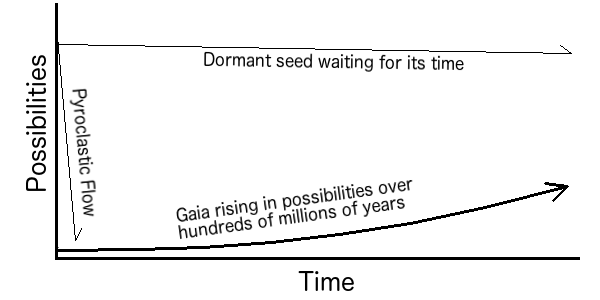 On the other hand, Lovelock pointed out that Gaia, the Earth and life as a whole has, over geologic time, risen upward from thermodynamic equilibrium into dramatically more Possibilities. Life did this, even while eating one another, thanks to the inflow of solar energy and the ability of life to absorb and transform that energy in wondrous ways. Over time, the ecological service work of moss mats and leaf dams, of salmon and gophers have built up The Commons that further alter rates of flows, allowing possibilities to accumulate ever faster on Earth.
Thermodynamic Velocity
Now, if the vertical-axis had simply represented distance from a starting point, then the graph would represent change of position over time. Each line’s arrow in the graph above would reveal that the position of the object being graphed had moved through a certain distance within the space of a certain time. With this information we could calculate that object’s average velocity. (For example, if it had changed its position by a distance of 50 miles within the last hour, then it would have an average velocity of 50 mph in a certain direction.) The greater the velocity, the steeper would be the slope of the graph’s line.
But instead of a distance, the vertical axes of our graph represent the Fifth Dimension of Possibilities. As rain walks practice me in seeing this Fifth Dimension, I start thinking of the steepness of the arrows on these graphs as representing something I call the Thermodynamic Velocity. In the graph of the dormant seed, the Thermodynamic Velocity is of a very slow decrease of Possibilities. In the graph of a volcanic eruption’s pyroclastic flow, the Thermodynamic Velocity is an explosively rapid decrease of Possibilities. Lovelock points out that life on Earth, over hundreds of millions of years has achieved a slow but upward (on average) Thermodynamic Velocity – from a Glacier Bay-like, pre-life, bedrock expanse to the prairies and forests we live within now.
The Thermodynamic Velocity of the seed and the pyroclastic flow, I call Downward. The Thermodynamic Velocity of Gaia, I call Upward. I will capitalize and italicize these two words when they refer to Thermodynamic Velocity. Upward does not necessarily imply a rising in height or elevation. Sometimes it might but usually not. However, just as it is easier to move downhill than uphill, so it is also true that an Upward velocity will be harder to achieve than a Downward velocity. (I will also capitalize and italicize the word Uplift when it refers to something’s Upward Thermodynamic Velocity made possible by a source of energy outside of that thing.)
When I think of the Earth’s Thermodynamic Velocity, I think of trillions of processes happening simultaneously. A rock tumbles down a slope. A rove beetle eats a maggot. A thunderstorm builds up over canyon country. A plant grows another leaf. The tide rises and falls. Snow falls on the upper slopes of a glacier. A flower develops into fertile seeds. In trillions of ways, usable energy is increasing here, decreasing there. The Earth’s Thermodynamic Velocity is the summation of all these processes, the Relative Balance between uplifts and downward flows.
This Relative Balance shifts through the seasons. The pulse of increasing sunlight lifts the spring and summer world. Life absorbs more and strengthens The Commons. Autumn into winter sees the sunlight diminish and the Relative Balance shifts. Days are less bright. Leaves fall. Far more animals die than are born.
But over hundreds of millions of yearly seasons, the Earth has slowly risen Upward into more possibilities. Not everything is rising. Rivers flow down. Plants decay. Animals are eaten. Mountains erode. Trillions of Downward flows are happening. But so, too, are trillions of Uplifts. There have been great die-offs and extinctions. Yet somehow, the Relative Balance of all of these flows over all of the Earth over hundreds of millions of years has been that the inflow of Possibilities is greater than the outflow of Possibilities and the Upper Level expression of The Commons has accumulated. That is an Upward Thermodynamic Velocity.
However, I, like many, feel that our accumulative effect on the Earth has turned its Thermodynamic Velocity Downward. This has deepened my koan to a different question: How can I best be part of a process of returning the Earth to an Upward Thermodynamic Velocity? The remaining chapters are tentative answers that have grown over the years of Chrysalis and rain walks.
Afterwords
Scientists have another way of looking at the Second Law of Thermodynamics called statistical thermodynamics that uses probability to predict the thermodynamic interactions of large systems. The system contains vast trillions of molecules. Each molecule has a wide variety of energy states available to it so it is impossible to predict which energy state a molecule will be in. However, dropping to a lower energy state is more accessible than rising to a higher state. Therefore, dropping occurs with greater probability. When one considers large systems of trillions upon trillions of molecules, the probability is infinitely close to 100% that over time, the system, on average, will occupy lower and lower energy states. Usable energy, the ability of energy to do work, will decrease. An increase in usable energy is not impossible in statistical thermodynamics; it is just extremely, extremely, extremely improbable.
This reminds me of Galton machines. The greatest probability is that each ball will bounce to the left as many times as it will bounce to the right (just like flipping a coin one hundred times will end up with around 50 heads and 50 tails. It usually won’t come out precisely half and half but it will be very close.) Therefore, at the bottom of the Galton machine, most of the balls will be near the center. To end up significantly away from the center, a ball has to significantly depart from the probable distribution of rights and lefts. The more pegs between the top and the bottom, the less probable it becomes for a ball to end up far to one side. To do that, a ball would have to bounce to the left (or right) almost every time, like flipping fifty heads in a row. It’s possible but highly improbable. Put a million pegs between the top and the bottom and it becomes realistically impossible for a ball to travel to the farthest possible edge of the distribution curve.
When I make my probabilistic shifts in the fields, I am altering that distribution pattern. Instead of flipping coins, I am deliberately placing them “heads up”, shifting runoff consistently onto slower paths. The result will be a skewed sample of heads, a skewed sample of Galton machine balls being led away from the center out towards the edge, of runoff ending up off to the side, on less probable paths where it will percolate into the drier side slopes and remain higher within the drainage than would otherwise occur. I think of myself as a biased peg in the Galton machine of the universe, looking for leverage points to bounce more of the balls coming my way out towards the edge so that they end up in a higher energy state than they otherwise would. Usable energy might still be decreasing but it is decreasing at a slower rate than before.
Next Chapter Table of Contents